Top Signs You Need Garage Door Service – Don’t Ignore These
A garage door that takes three seconds longer to open than it did six months ago isn’t aging – it’s telling you one of four specific things is wearing out, and at least two of them will strand your car inside when they finally go. The costliest failures in North Ward don’t arrive without warning. They’re preceded by weeks of small signals homeowners file away as “just how it sounds now.” Here’s how to read those signals before they become a repair bill.
If you’d rather not climb a ladder and test things yourself, call (844) 905-3092. We’ll tell you what’s actually going on.
Why “It Still Opens” Isn’t the Same as “It’s Fine”
A garage door is the heaviest moving object in most homes, strung between high-tension springs, cables, rollers, hinges, and a motor doing precise load calculations on every cycle. When one part starts to fail, the others compensate. That’s why a door keeps working long after it’s telling you something is wrong – the system routes around the damage. Then it stops routing, usually at 7 a.m. when you’re already late for work.
In our experience across North Ward, homeowners tend to normalize three categories of decline: a slower opening cycle, a new sound, and a door that sits slightly off-level. All three point to specific components, and they carry very different repair costs. A worn roller is a small bill. A spring losing tension under a motor working overtime can take the opener with it.
The trick is separating cosmetic noises from distress signals. Below, each symptom is tied to the component behind it – and to why the timing matters.
Key Takeaways:
- A slower door is usually spring tension loss, roller drag, or motor strain – three different fixes, three different costs.
- Where the grinding happens (top of travel vs. mid-travel) tells you which assembly is failing.
- An uneven door is always structural, never cosmetic.
- The safety reversal test takes 30 seconds and should happen every season.
- Cable fraying and spring gaps are two things you can check with your eyes, no tools, once a month.
The Slow Creep: What a Door That “Just Feels Heavier” Is Telling You
When a door takes noticeably longer to rise or feels like it’s dragging halfway up, the cause is almost always one of three things. They read the same from the driver’s seat but aren’t the same repair:
- Spring tension loss. Torsion springs are under enormous tension by design, and they weaken gradually before they fail outright. A spring with reduced tension means the opener is lifting weight it wasn’t rated to carry. This is the most expensive of the three, in part because springs should always be replaced as a matched pair.
- Roller degradation. Worn or flat-spotted rollers create drag along the track, and the motor fights through it on every cycle. Rollers are the cheapest fix of the three and the one most often skipped, which lets the drag wear the opener out over months.
- Motor strain. If the door is a symptom and the motor is the cause, the opener’s drive system is struggling – the internal gear, the belt, or the logic board hunting for position. On Clopay and Amarr doors paired with LiftMaster or Chamberlain openers, we can often tell which of the three you’re dealing with by listening once, because the brand combination behaves in predictable ways.
The sequence matters: a dragging roller causes motor strain, and a weak spring causes both. Catch it at the roller stage and you spend the least.
Grinding at the Top of Travel vs. Mid-Travel: Two Different Problems
Where in the cycle the grinding happens is the diagnostic detail most homeowners miss. It points to two entirely different assemblies:
- Grinding at the very top of travel – the door reaches full open and shudders or grinds at the top. This is usually the door hitting the open limit or riding against the opener’s upper track curvature, which can mean a worn top roller, a misaligned track, or a limit switch in the motor that’s drifted. Left alone, the door can slam down on the next cycle.
- Grinding mid-travel – roughly the middle of the cycle on the way up or down. That sound typically comes from the spring tube, a worn bearing plate, or a cable running against the drum. Mid-travel grinding is the more serious of the two, because it can be the precursor to a cable leaving its drum.
In our experience servicing North Ward homes, the mid-travel grind is the sound homeowners call about last, because it comes and goes. It doesn’t come and go – it tracks with cycle position.
What You Can Check Monthly Without Tools
You don’t need to disassemble anything to spot early failure. Three visual checks, done once a month, catch the issues that escalate fastest:
- Cable fraying. Look at the cables on each side of the door. A healthy cable is smooth and taut. Frayed strands, kinks, or a cable sitting off its drum are urgent – don’t operate the door and don’t try to adjust it yourself. Cables are under the same tension as springs and snap without warning.
- Spring gaps. On a torsion spring (the coiled unit above the door), a visible gap or separation in the coil means the spring is failing.
- Roller deformation. Eyeball the rollers in the track. Flat spots, cracks, or wobble mean replacement is due.
Springs and cables are the two parts you inspect, never adjust. The tension stored in them can cause serious injury even to someone who has done it before. This is what specialists mean when they say springs are not a DIY repair – the repair itself is one bad move from a hospital visit, and the wrong spring on the wrong door makes the math worse. If you see a gap or fraying, stop operating the door and call a specialist.
When to call a pro: any time a symptom involves the springs, cables, or a door that won’t move cleanly. That’s not a job for a generalist handyman, and it’s why even strong multi-trade contractors typically outsource it.
An Uneven Door Is Structural, Not Cosmetic
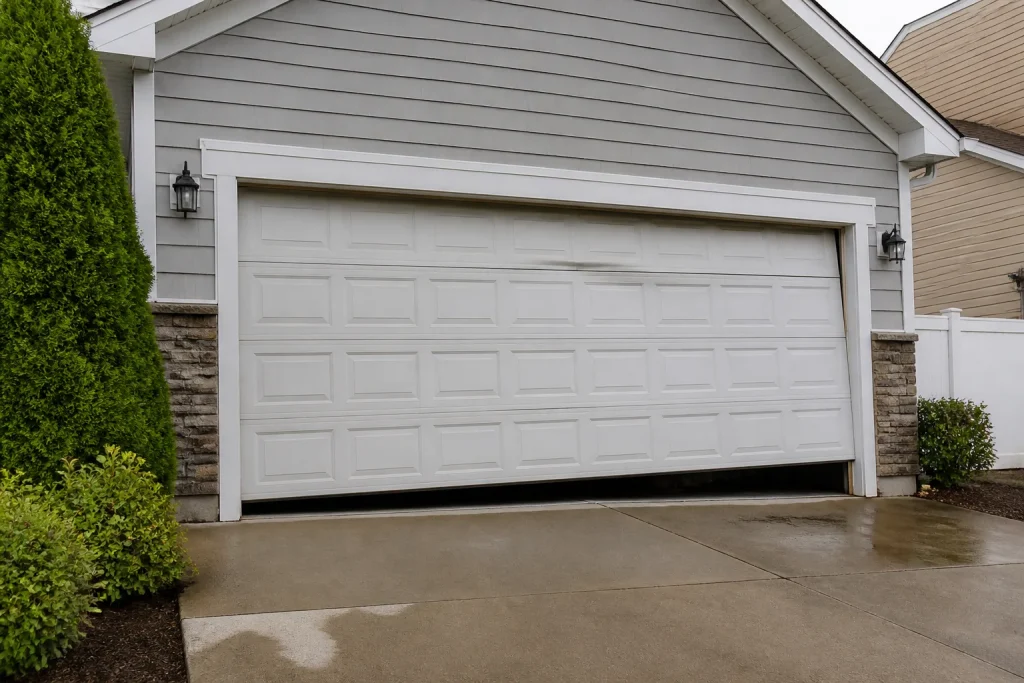
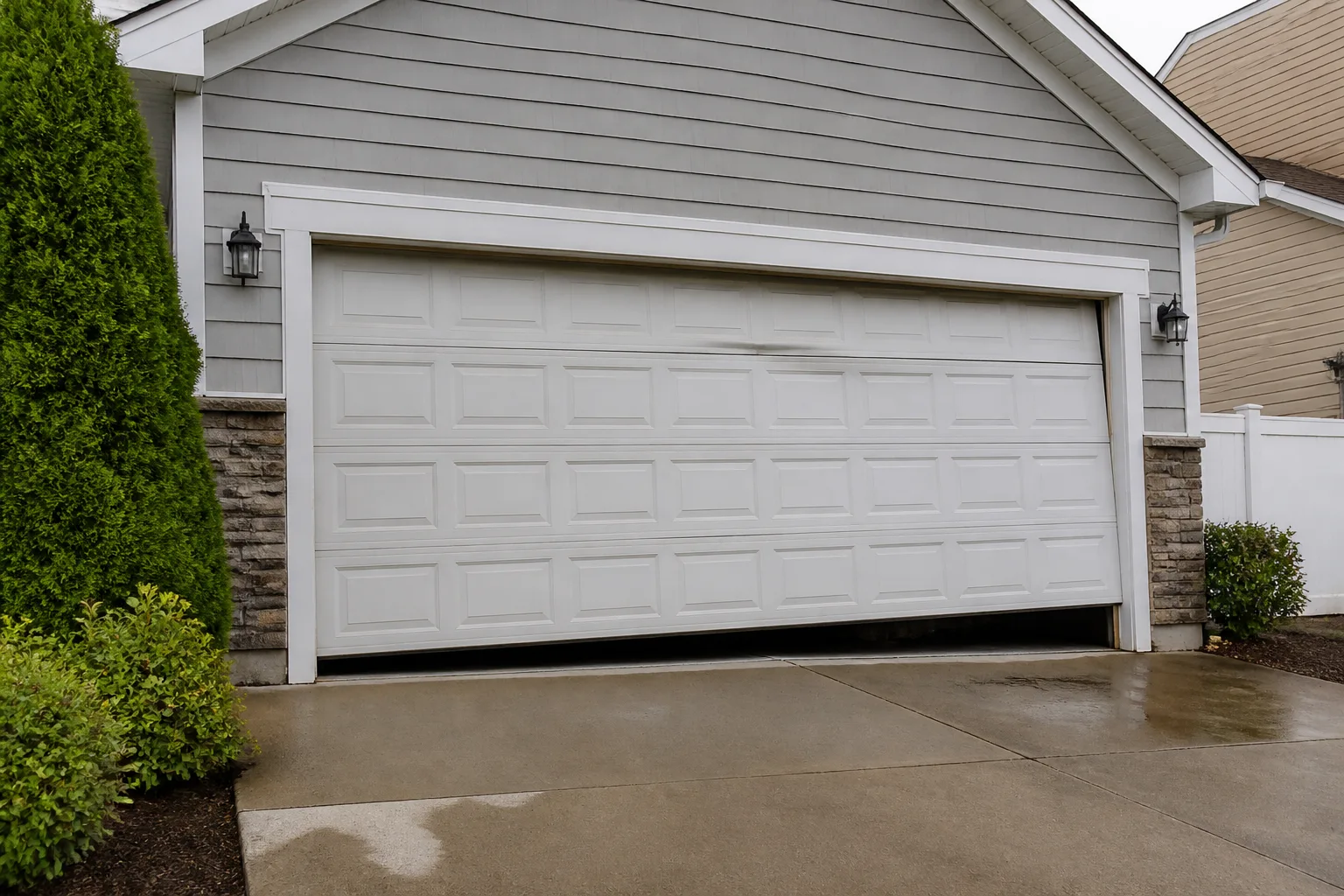
A garage door that sits lower on one side looks like a minor annoyance. It isn’t. In every case, an uneven door means the lifting force is asymmetric, and asymmetric force loads one side of the system past design. The causes are usually a stretched or failing spring on one side, a bound track, or a worn hinge set pulling the panel out of square.
What makes an uneven door urgent is what happens next. As one side carries more weight, the panels torsion and twist, and a strained panel can crack at the hinge line. Then the door torque loads the track, the track bends, and the door leaves its guides. That’s when a repair can’t wait and emergency service becomes the only option. If your door sits unevenly in North Ward, get it looked at before the next big storm cycle, when the door has to hold against wind loading it’s not rated to fight when it’s already off-level.
The Safety Reversal Test You Should Do Every Season
Every garage door opener has a safety reversal system – the mechanism that stops and reverses the door when it meets an obstruction. It exists because the door is powerful enough to injure. Inside, it’s a small sensor or a force-sensing circuit in the opener, and it can drift or fail silently.
To test it: lay a solid object (a piece of wood or a roll of tape works) on the floor in the door’s path, then run the door down. If it doesn’t reverse on contact, stop using it and get it serviced. A failed reversal test isn’t a cosmetic issue. It’s a door that will close on a child or a pet without slowing – and in the event of an injury, the failure of that system is treated seriously. The practical stakes are just as real: a door stuck closed is a schedule emergency, and getting the safety system confirmed working is a five-minute call once you’ve spotted the problem.
The Bottom Line
Read the small signs as what they are: the door telling you which component is losing tension, drag, or alignment. A slower cycle, a grind that tracks with position, a visual gap in a spring, an uneven panel – each one links to a specific part and a specific repair. Catching them at the earlier stage almost always costs less, and it keeps a routine repair from turning into an emergency call. We work on Clopay, Amarr, Wayne Dalton, Craftsman, and the leading openers, so the fix is matched to the equipment rather than guessed at.
If you’re in North Ward and need help, Garage Door Repair North Ward offers free estimates – call (844) 905-3092. Our technicians have up to 13 years of experience, and we’re equipped for both garage door repair and garage door opener repair, including emergency service, so one call covers the whole problem.
Frequently Asked Questions
If the door moves, reverses, and sits level, it usually needs an adjustment – track alignment, opener limits, or roller replacement. If it grinds mid-travel, hangs uneven, or the safety reversal test fails, it needs repair. A free estimate tells you which.
Not always, but the location of the noise tells you. Grinding at the top of travel usually points to limit or track issues. Grinding mid-travel points to the spring tube or drum and is the more serious of the two. A steady new rattle is often a loose hinge or roller – a small fix.
No. Springs are high-tension components, and the stored force can cause serious injury. Even experienced tradespeople outsource this. Springs are a specialist repair, and a matched pair should be replaced together.
It means the lifting force is asymmetric – typically a failing spring on one side, a bound track, or worn hinges. Always structural, never cosmetic. Get it checked before the strain damages the panels or the track.
Written by the team at Garage Door Repair North Ward.
Need Garage Door Help?
Call Garage Door Repair North Ward - the local pro we connect you with is licensed and insured, here with fast after-hours help in North Ward.
(844) 905-3092