Garage Door Repair: Repair or Replace? How North Ward Homeowners Decide
Most North Ward homeowners assume a door’s age settles the repair-or-replace question. It doesn’t. A 15-year-old door with one broken panel isn’t automatically a replacement candidate, but that same door with a third spring repair in four years, insulation performance that’s dropped off, and a home going on market in 18 months almost certainly is. The math gets obvious once you run all three factors together instead of one at a time. If you’d rather not work through the numbers yourself, call (844) 905-3092 and we’ll walk you through it.
Start With the Repair-to-Value Ratio, Not the Age
A useful rule of thumb: when the cost of the next repair climbs past roughly a third of what a new door would run, replacement usually wins. But that ratio means nothing on its own, because the real question is cumulative. What matters is how much you’ve already spent on the current door and how much more it’s likely to ask for.
Here’s how to work it out:
- Add up your repair spend over the last four to five years. Spring replacements, opener fixes, cable work, track realignment. Include the small stuff you paid a handyman to handle.
- Estimate the next repair. A door that’s had two spring replacements in four years is telling you something about the rest of the hardware. Expect the next one sooner rather than later.
- Compare that total to the cost of a new door in the style and material you’d actually choose, not the cheapest option on the shelf.
When past repairs plus the likely next repair approach or exceed that replacement number, you’re no longer maintaining a door. You’re funding a slow replacement one invoice at a time. In our experience, that crossover point arrives faster on doors with repeated spring failures, because springs and the hardware around them wear together.
One thing this calculation is not: a repair-versus-replace call on the cheapest fix, like a single broken panel or a failed opener, is usually just a repair. Don’t replace a sound door because one part gave out.
How North Ward’s Climate Affects Insulated vs. Non-Insulated Doors
North Ward’s cold winters and hot, humid summers put real stress on a garage door. An attached garage shares at least one wall and often a ceiling with the house, so a poorly insulated door lets summer heat and winter cold pour into the rooms above and beside it. That’s a comfort problem first and an energy cost second, but both show up on your bills.
What matters more than the R-value printed on a label is the condition of the door you already have.
- Insulated doors (foam-filled panels) hold their performance as long as the panel skin stays intact. A dented or water-damaged section loses insulation value fast because moisture gets into the core.
- Non-insulated steel or wood doors provide almost no thermal break. If your garage stays noticeably hotter or colder than the rest of the house, the door is usually a big reason.
- Weatherstripping and bottom seals degrade quietly. Worn seals let air in around the edges regardless of what’s inside the panels.
If your door is solid but uninsulated, replacing the panels or moving to an insulated model is a comfort and efficiency upgrade. If it’s insulated but the skins have failed in multiple sections, replacement is the more honest spend. Ask us about garage door installation if you want to compare insulated options for your home.
Panel Damage: When a Single Replacement Is Valid and When It Isn’t
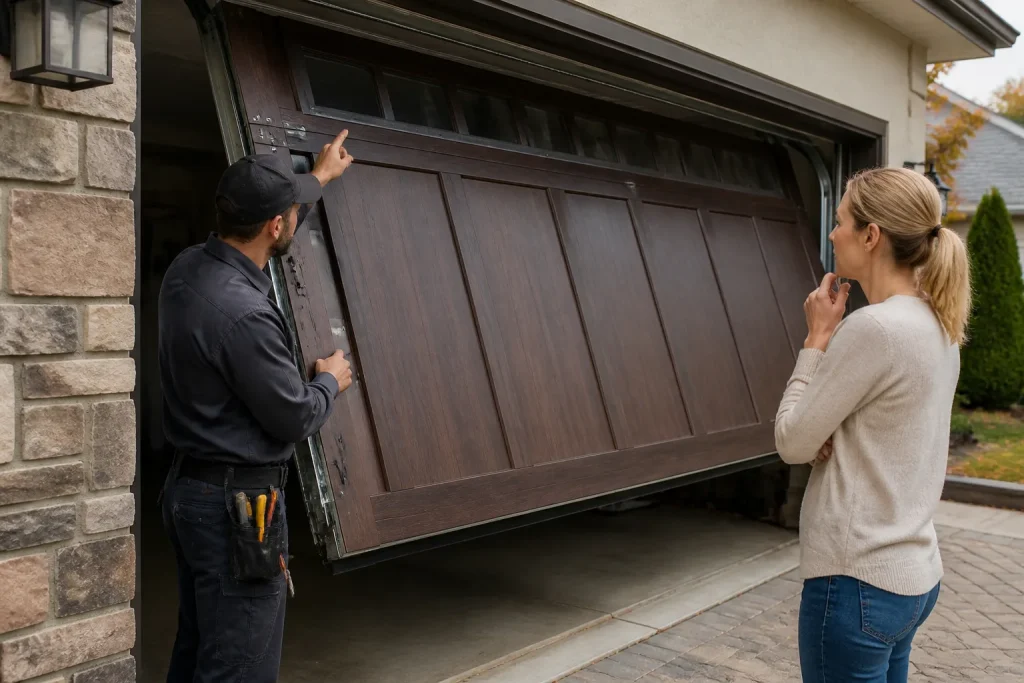
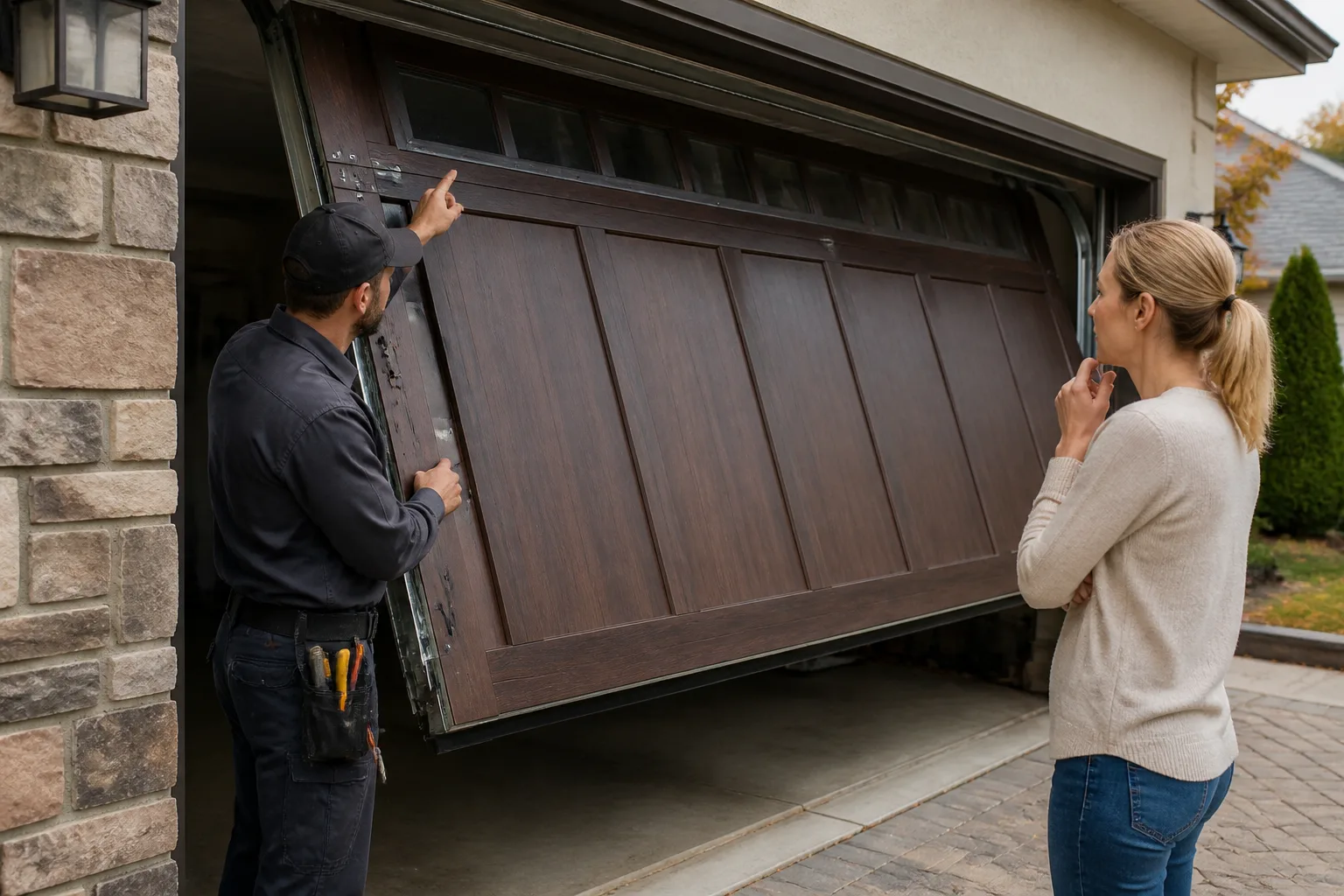
A single panel replacement is structurally sound when the door’s frame, tracks, and torsion system are healthy and the damage is isolated. It’s a cosmetic patch on a compromised frame when the panel failure happened because the door is bent, binding, or carrying tension unevenly.
Ask three questions before you order a panel:
- Did the door damage one panel, or did a mechanical problem damage the panel? A door that jumped its track and crumpled a section needs track and hardware work, not just new metal.
- Can the exact panel still be matched? Clopay, Amarr, and Wayne Dalton all make replacement panels, but colors fade and profiles get discontinued. A mismatched panel is a permanent reminder.
- Is the surrounding frame straight and rust-free? A panel bolted onto a bent section will fail early.
When the damage is genuinely isolated, a panel swap is the right fix and you should hear that from a technician willing to say so. When it isn’t, replacing one panel to save money now usually means paying for a full door in a year anyway. That’s the difference between the right fix and the easy upsell, and it’s a distinction worth asking about directly.
The ROI Case for Replacing Before a Home Sale
Replacing a worn garage door before listing is one of the more reliable moves in home preparation because buyers see the door first, and a struggling door reads as deferred maintenance. The current door is often the largest flat surface facing the street, so its condition sets the tone before anyone walks inside.
Here’s the case in plain terms:
- Buyers budget for problems they can see. A dented, noisy, or non-functional door invites a lower offer or a repair credit request, even when the cost of a new door is modest.
- Curb appeal carries more weight on photos-first listings. The front of your home is the first thing every buyer sees online; a tired door undercuts the whole set.
- A new door with a warranty removes a negotiation point. You control the fix before it becomes the buyer’s leverage.
The math works best when you’re 12 to 24 months out and the current door is already near the replacement threshold. If you’re selling far sooner or the door is in good shape, a repair to get it working cleanly is the smarter spend. If you’re a year or two away and the door has been limping along, the replacement pays for itself in a smoother sale.
What a Full Replacement Actually Involves
Most of the hesitation around replacement comes from a wrong picture of the process. Homeowners imagine days of noise and a torn-up garage. The reality is a single-day job on most homes, with the old door and tracks removed and a new door installed in sequence.
What stays and what goes:
- Goes: the door panels, the tracks, the springs, cables, rollers, and hinges. All of that hardware is matched to the new door’s weight.
- Stays: the garage structure, the opener in most cases (unless it’s nearing the end of its life or incompatible), and the walls around the opening.
- Scheduled, not rushed: replacement is measured and ordered, so there’s a short wait between the free measure and install day. That’s normal.
Brand matters here because fit and parts availability vary. Clopay, Amarr, Wayne Dalton, and Craftsman doors all install cleanly when measured correctly, and a contractor who works across brands will steer you to what fits your opening rather than what’s on hand. We’re factory-familiar with those lines, so if your opener carries a LiftMaster or Chamberlain unit, the door install can be coordinated with your existing electronics rather than forcing a new opener purchase. Ask for a written price after the measure. The written quote is the price, and it’s agreed before any work starts.
When to Call a Pro
Some of this you can inspect safely: look at the door from the ground, watch the travel, listen for grinding or popping. But springs, cables, and torsion hardware are high-tension components. A wound spring under load can release with enough force to cause serious injury, and that’s not a repair to attempt on your own. When a spring snaps, a cable breaks, or the door comes off its tracks, stop using the door and call a trained professional. Our technicians handle spring repair as a core specialty, because it’s a safety-critical job many generalists avoid or farm out.
Emergency garage door service is available for situations that can’t wait: a stuck-open door leaves the home unsecured, and a stuck-closed door traps a car and disrupts the day. Note that if it’s a Saturday, we’re closed; call and we’ll book you for Sunday. Our technicians have up to 13 years of experience working across LiftMaster, Chamberlain, Genie, Clopay, Amarr, Wayne Dalton, Craftsman, and Raynor equipment, so they diagnose by the brand’s own logic rather than guessing. If you suspect a failed opener rather than a door problem, garage door opener repair covers the electronics and drive systems separately from the door’s mechanical hardware.
Related services in North Ward
If you need a hand deciding, garage door repair is the place to start for a diagnosis, and Garage Door Repair North Ward covers everything from snapped springs to full replacements if you want the whole picture.
What happens when you call
- 1
A real person answersNo phone trees – you reach a local pro.
- 2
You get an upfront price rangeHonest numbers before anyone is dispatched.
- 3
A background-checked tech heads outLicensed & insured, dispatched right away.
- 4
You approve before work beginsNothing starts until you say go.
The Bottom Line
Run the three factors together before you decide: cumulative repair spend, insulation performance, and your resale timeline. A door that’s cost you repeated repairs, doesn’t hold temperature, and sits in a home you’re listing in the next year or two is ready to go. A sound door with one bad panel or a failed opener is a repair. Age alone rarely settles it. If you’re in North Ward and need help weighing it out, Garage Door Repair North Ward offers free estimates and a written price before any work begins. Call (844) 905-3092.
Frequently Asked Questions
Add up your repair costs over the last four to five years and compare that total to the cost of a new door. If the combined past repairs and the likely next repair approach the price of a replacement, replace it. If the door is mechanically sound with one isolated fault like a panel or opener, repair it. Insulation condition and how soon you plan to sell round out the decision.
Yes, when the damage is isolated and the frame, tracks, and springs are healthy, and when the panel profile and color can still be matched. It’s not valid when a mechanical problem like a jumped track caused the damage, or when the surrounding sections are bent or rusted. A technician should diagnose the cause before ordering a panel.
It does, because North Ward winters are cold and summers are humid, and most attached garages share a wall with the house. An insulated door slows heat transfer and keeps the garage more stable. The benefit fades if the panels are dented or water-damaged, so condition matters as much as the insulation rating.
Often yes, particularly when you’re 12 to 24 months from listing and the current door is already near the replacement threshold. A new door with a warranty removes a visible maintenance concern and a negotiation point, and it improves the first impression buyers get online. If you’re selling far sooner or the door is in good shape, a repair is the better move. Call (844) 905-3092 for a free estimate on either path.
Written by the team at Garage Door Repair North Ward.
Need Garage Door Help?
Call Garage Door Repair North Ward - the local pro we connect you with is licensed and insured, here with fast after-hours help in North Ward.
(844) 905-3092